The Draft Model’s Report Card
16 drafts, graded twice: against the teams and against itself. The stars it saw coming, the ones it didn’t (hello, Nikola), and what it makes of the 2026 class.
Let’s start with my miss, since I promised I would. On draft night in 2017 the Celtics traded down and took Jayson Tatum third, and I was furious about it. I had reasons. They were bad reasons. He finished first in his class. I will ride for him forever, and I will never again trust myself on a draft night.
The model, for the record, had him 4th. Neither of us had him first. It at least had the decency to be close.
So this column grades the model the way I should have been graded. The rules first. Before every draft since 2007 the model ranked every prospect it could find, college and international, using only what was known that spring.1 Then we wait four seasons and see who was right: the model, or the thirty front offices who actually made the picks. 16 classes have closed. The model ranked the players better than the draft order did in 14 of them.2
A note on the scale: the board scores each player’s first four seasons, quality times availability, on its own ruler. For reference, the median first-round pick since 2007 scored 0.8. Where it helps, the tables also give career wins above replacement, which is the ruler the rest of this site uses.
The hits
These are the players the model ranked at least ten spots above where they were drafted, who then finished top five in their class. This is the list a front office would pay for.
| Class | Player | Pick | Model rank | Finished | Career WAR |
|---|---|---|---|---|---|
| 2011 | Isaiah Thomas | 60 | 16 | 5th | 42.9 |
| 2012 | Draymond Green | 35 | 6 | 2nd | 109.8 |
| 2016 | Malcolm Brogdon | 36 | 9 | 5th | 31.1 |
| 2017 | Derrick White | 29 | 5 | 5th | 59.4 |
| 2011 | Jimmy Butler | 30 | 8 | 2nd | 138.3 |
| 2020 | Desmond Bane | 30 | 14 | 4th | 42.7 |
| 2012 | Jared Sullinger | 21 | 5 | 5th | 16.7 |
| 2009 | Ty Lawson | 18 | 2 | 5th | 44.7 |
| 2013 | Rudy Gobert | 27 | 13 | 2nd | 112.9 |
| 2015 | Josh Richardson | 40 | 26 | 5th | 14.4 |
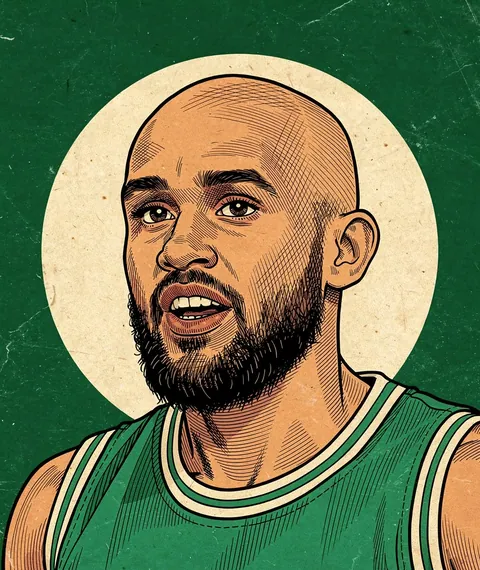
Some of this is the model doing what models do: it doesn’t care that a player is 22, or undersized, or from a school nobody visits. I’ll admit the row that makes me happiest is a Celtic’s: Derrick White, drafted 29th, ranked 5th by the model, finished 5th. I will ride for Derrick White forever, and now I have a spreadsheet that says I’m allowed to.
And one that isn’t on the table, because he went where he should have: in 2014 the model’s number one prospect was Marcus Smart. He went 6th and finished 3rd in a class with an MVP in it. I have never loved a model more.3
The misses
Now the part the model would rather skip. Two kinds of miss: stars it ranked far too low, and players it loved who didn’t pan out.
| Class | Player | Pick | Model rank | Finished | Career WAR |
|---|---|---|---|---|---|
| 2014 | Nikola Jokić | 41 | 56 | 1st | 199.9 |
| 2007 | Marc Gasol | 48 | 54 | 2nd | 92.6 |
| 2021 | Herbert Jones | 35 | 53 | 3rd | 25.6 |
| 2020 | Immanuel Quickley | 25 | 32 | 2nd | 37.1 |
| 2013 | Giannis Antetokounmpo | 15 | 32 | 1st | 157.7 |
| 2015 | Myles Turner | 11 | 28 | 3rd | 53.2 |
At the top of the first list, and at the top of every list of draft misses ever made, is Nikola Jokić. The model ranked him 56th in 2014. Worse, its middle projection for him was the floor: the model’s best guess was that he would never stick in the league. He has 199.9 career wins above replacement. In fairness to the model, the league let him go 41st, and the pick was announced while the broadcast was showing a Taco Bell commercial.4 The fair objection, which Professor Voss would raise before I finished the sentence: the model learned from players who looked like Jokić at nineteen, and almost none of them became Jokić. That isn’t a bug. It’s what a base rate is. It’s also cold comfort.
The other kind of miss is quieter and more expensive, because it’s the kind a team acts on:
| Class | Player | Pick | Model rank | Finished | Career WAR |
|---|---|---|---|---|---|
| 2011 | Brandon Knight | 8 | 2 | 48th | -4.8 |
| 2017 | Markelle Fultz | 1 | 3 | 37th | 3.9 |
| 2010 | Xavier Henry | 12 | 3 | 34th | 0.2 |
| 2014 | Jordan Adams | 22 | 2 | 30th | 0.4 |
| 2015 | D'Angelo Russell | 2 | 2 | 25th | 27.0 |
| 2018 | Wendell Carter Jr. | 7 | 3 | 19th | 18.4 |
These were the model’s top-three prospects who finished well down their class. Brandon Knight was its number 2 in 2011 and finished 48th. Some of these are injuries, which no draft model sees coming, and some are just the model being wrong. It doesn’t get to choose which.
Since we’re being honest: in 2016 the model had Jaylen Brown 11th, and the Celtics took him 3rd. He finished 9th in his class over those four years, which is closer to the model than to the pick, and then he spent the next decade making the model look silly. I wanted Boston to keep him. The model and I are still not talking about it.
Graded against itself
The lists above grade the model against the teams. This one grades it against its own projection: the biggest gaps, either way, between what it expected of a player and what he did.
| Class | Player | Pick | Expected | Actual | Gap |
|---|---|---|---|---|---|
| 2014 | Nikola Jokić | 41 | -4.0 | 12.6 | +16.6 |
| 2012 | Damian Lillard | 6 | 0.9 | 13.3 | +12.4 |
| 2012 | Khris Middleton | 39 | -4.0 | 6.8 | +10.8 |
| 2008 | Russell Westbrook | 4 | 0.7 | 10.7 | +9.9 |
| 2009 | Nick Calathes | 45 | 2.5 | -4.0 | -6.5 |
| 2012 | Royce White | 16 | 2.1 | -4.0 | -6.1 |
| 2020 | Xavier Tillman Sr. | 35 | 1.4 | -4.0 | -5.4 |
| 2007 | Taurean Green | 52 | 1.2 | -4.0 | -5.2 |
The top four are the stars it undersold; the bottom four are the prospects it expected to play who never stuck. Notice the shape. The model’s misses on the low side are enormous, because stars are enormous, and its misses on the high side are capped at the floor, because the worst a prospect can do is not play. That asymmetry is the whole economics of the draft, and I have promised to keep the economics in the footnotes.5
The 2026 class
The draft was in June, so we can do something we couldn’t do for the old classes: put the model’s board right next to where everybody actually went, and wait. Here is its top ten, with its middle projection and the range it gives from a bad outcome to a good one.
| Model rank | Player | From | Pick | Expected | Range |
|---|---|---|---|---|---|
| 1 | Cameron Boozer | Duke | 3 | 5.2 | -2.9 to 8.7 |
| 2 | Keaton Wagler | Illinois | 5 | 2.8 | -1.1 to 4.8 |
| 3 | AJ Dybantsa | BYU | 1 | 2.4 | -2.5 to 6.0 |
| 4 | Maliq Brown | Duke | 44 | 2.3 | -0.9 to 4.8 |
| 5 | Allen Graves | Santa Clara | 19 | 2.2 | -0.9 to 4.7 |
| 6 | Yaxel Lendeborg | Michigan | 11 | 1.8 | -0.6 to 4.6 |
| 7 | Caleb Wilson | UNC | 4 | 1.8 | -1.5 to 4.1 |
| 8 | Ebuka Okorie | Stanford | 17 | 1.5 | -0.8 to 4.1 |
| 9 | Labaron Philon Jr. | Alabama | 22 | 1.5 | -0.6 to 4.2 |
| 10 | Bennett Stirtz | Iowa | 16 | 1.4 | -0.5 to 3.2 |
Range: the model’s 10th to 90th percentile outcome on the board’s four-year scale.
The model’s number one is Cameron Boozer, who went 3rd. The first pick, AJ Dybantsa, is 3rd on its board, which isn’t a knock so much as a coin the model flipped the other way. Ask me again in four years.
The disagreements are further down. The model’s favourite bargains, drafted well below where it ranked them:
| Player | From | Pick | Model rank | Age |
|---|---|---|---|---|
| Maliq Brown | Duke | 44 | 4 | 22.6 |
| Henri Veesaar | UNC | 52 | 23 | 22.2 |
| Trey Kaufman-Renn | Purdue | 59 | 34 | 23.8 |
| Emanuel Sharp | Houston | 45 | 26 | 22.3 |
| Izaiyah Nelson | South Florida | 51 | 32 | 22.7 |
Maliq Brown went 44th. The model had him 4th in the class. That is the biggest disagreement on the board, and here is my call, for the ledger: I’m with the model. Mikey, from the group chat, says a 23-year-old who went 44th is a 23-year-old who went 44th for a reason. Mikey has a point. Mikey also wants to trade for him.
And the picks it would not have made, taken well above where it ranked them:
| Player | From | Pick | Model rank | Age |
|---|---|---|---|---|
| Narcisse Ngoy | International | 57 | 143 | 21.9 |
| Cameron Carr | Baylor | 24 | 93 | 21.6 |
| Jaron Pierre Jr. | SMU | 58 | 122 | 24.0 |
| Otega Oweh | Kentucky | 41 | 89 | 23.0 |
| Jayden Quaintance | Kentucky | 20 | 55 | 19.0 |
Teams watch these players in workouts, meet their families, and know things about their medicals that no model will ever see, so some of these “reaches” are just information the model doesn’t have. The point of the list isn’t that the teams are wrong. It’s that we’ll know, and in four years I’ll open that column with whichever of us looks worse.
Figures: the draft board, classes 2007 to 2022 out-of-fold, and the 2026 class as projected; career WAR from the players board, as of this build. Wins are on this model’s own scale and dollars at the open-market price of a win; the method explains both.
- Out-of-fold: each class was ranked by a version of the model that never saw that class, so none of these calls leaned on hindsight. The draft method has the details. ↩
- Rank correlation with each drafted player’s realized four-year value, within the class. The draft wins the other two. Nobody should read that as the model being smarter than a front office. It is cheaper than one, and it never falls in love with a workout. ↩
- Deb, from the group chat, would like it noted that she has been saying this since the combine. Deb has been saying a lot of things since the combine. ↩
- The model didn’t watch that either. ↩
- Fine. A pick is a call option: the downside is the rookie-scale salary and a roster spot, the upside is uncapped. Options are worth more the wider the range, which is why the model reports a range, and why a team should sometimes take the prospect with the wider fan over the one with the higher middle. Professor Voss, you may stop reading now. ↩